
BTU CALCULATOR
We’ve taken our proven formulas and designed this easy-to-use BTU calculator.
How to Use the BTU Calculator
This tool is designed for industrial users, contractors, and anyone managing temporary or permanent worksites who needs to determine the right capacity for an HVAC system. Accurate BTU calculation is essential for choosing the correct heater size, ensuring energy efficiency, comfort, and cost savings.
BTU calculators factor in space dimensions and insulation quality, and also consider other important factors such as sun exposure, ceiling height, and climate. Insulation quality, for example, directly affects the BTU requirements for heating or cooling, as it impacts heat gain and loss in a space. Higher ceilings increase the total cubic volume and require adjustments in BTU calculation. Extreme climates demand more capacity adjustments compared to milder regions.
Use the Calculator
Fill out the fields below to calculate the BTU/hr (imperial) or Watts (metric) required for your worksite. Select an R-Value number between 1-40 for each input field. Use this number as a guideline when choosing what size of industry heater you will need.
Once you’ve gathered your information, use the calculator below to estimate your BTU requirements. For more details, see our Frequently Asked Questions.
- Important:
Online calculators provide rough estimates but cannot replace professional load calculations.
Extreme climates demand more capacity adjustments compared to milder regions.
Higher ceilings increase total cubic volume and require adjustments in BTU calculation.
Understanding R-Value
R-Value is a measure of the capacity of an insulating material to resist heat flow. The higher the R-value, the greater the insulating power. In BTU calculations, R-Value helps determine how much energy is needed to maintain the desired temperature inside a space. If you are unsure of your site’s R-values, we recommend using the standard unit of “1” in all input fields, which will assume moderate insulation.
Building Tightness
Building tightness is a measure of the leakage of air from a building. It is defined as the fraction of the air volume of a building that leaks out of the building per hour (units: 1 / hr). The lower the value, the tighter the building is. In BTU calculations, building tightness helps account for energy lost through air leaks, gaps, and openings.
Incredibly Cost-Efficient
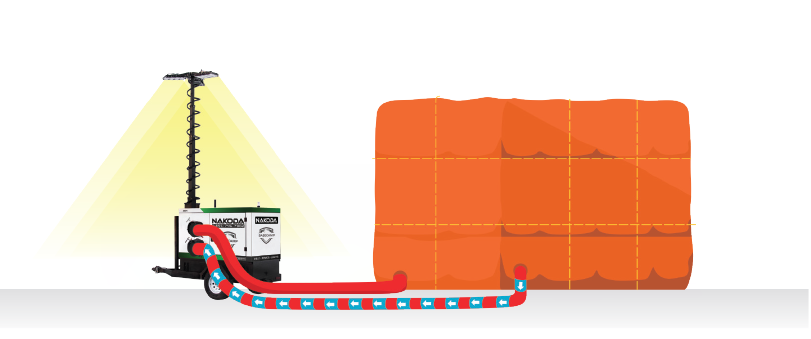
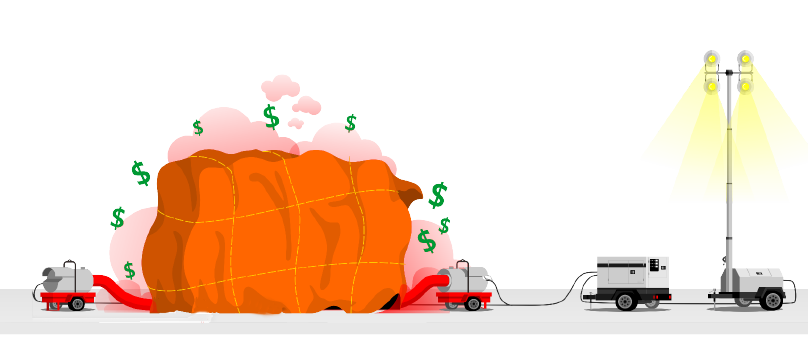
The NAKODA BASECAMP can replace two traditional indirect Flamed Heaters, one Generator, and one Light Tower all while burning 60% less fuel.
There’s only one question: What will you do with all that extra budget?
Our revolutionary SmartTalk connected technology increases efficiency by up to 400% by eliminating hot laps, and reducing fuelling labor costs. With real-time 24/7 monitoring, you can make your heating program your superpower!
Frequently Asked Questions
What does this BTU calculator actually work out?
One thing only: the BTU/hr (or Watts) of heat your worksite needs. BTU calculators factor in space dimensions and insulation quality. A BTU calculator estimates heating or cooling needs for spaces and outputs a target BTU range or specific capacity for HVAC systems.
It is an industrial sizing tool, not a home heating calculator, so it will not price a rental, weigh other project factors, or tell you the required number of units. BTU measures energy needed to heat one pound of water by 1°F.
Our team confirms that once you have your number.
What information do I need before I start?
Before using the calculator, gather the following information:
- Length, width, and height of the space in feet (ft)
- An R-value for each of the six surfaces
- Your expected outdoor temperature
- Your desired internal temperature
- How tight the structure is
Does it use an outdoor temperature difference factor or an insulation factor?
Not in the simplified way residential tools do. Rather than applying one insulation factor to the whole building, you enter an R-value per surface.
The temperature difference comes from the outdoor temperature and the internal temperature you set.
Can I use it for hoarding or a partially open space?
Yes. Enter the dimensions of the enclosed volume, however the walls are erected: plastic sheeting over a frame, insulated panels, or tarps on scaffold.
For a partially open space, or a structure with many walls still missing, choose a looser tightness setting so the energy lost through open space, gaps and doors is accounted for.
Why doesn’t it ask about windows or square feet required number?
No, those inputs belong to residential calculators, which size a room by square feet and ask whether the main walls face outside or how many windows are installed.
A temporary industrial enclosure rarely has windows installed at all, and its heat loss is driven by volume, R-value and air leakage. Openings such as doors, or windows covered with plastic, are handled by the tightness setting instead.
Why do insulation quality, sun exposure, ceiling height, and climate matter for BTU calculations?
BTU calculators consider factors like insulation, sun exposure, ceiling height, and climate because these elements impact how much energy is needed to maintain a comfortable temperature. Insulation quality affects the BTU requirements for heating and cooling by influencing heat gain and loss. Sun exposure can increase heat gain, while higher ceilings and extreme climates require adjustments in BTU calculation to ensure adequate capacity.